What Is a Data Pipeline? A Beginner's Guide
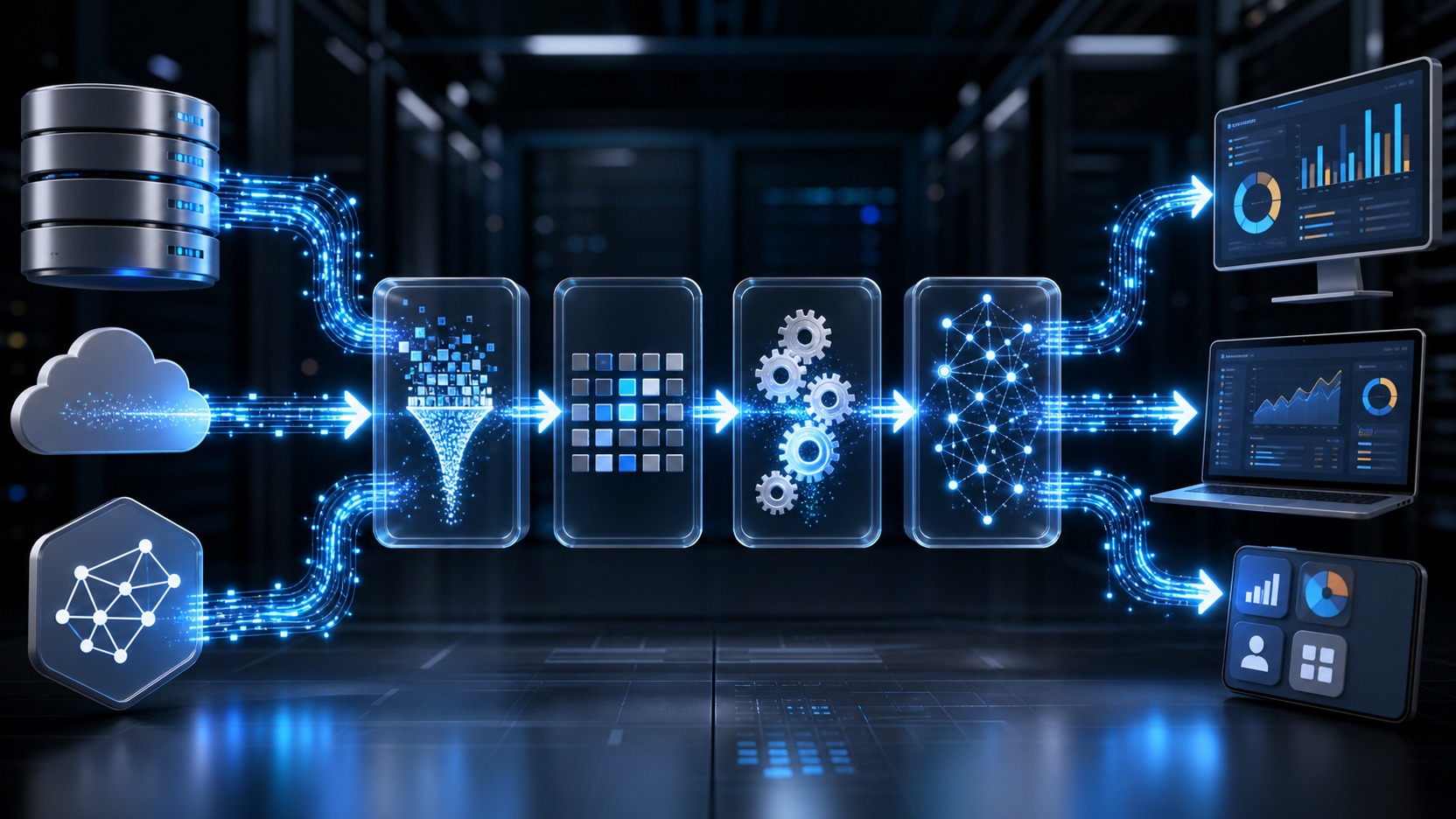
Ask ten engineers ‘what is a data pipeline’ and you’ll get ten answers, but they all point at the same simple idea: it’s the automated path data takes from where it’s created to where it’s used. This guide is for beginners and career-switchers who keep meeting the term and want it to finally click. We’ll cover the stages every pipeline shares, the difference between batch and streaming, and a concrete example you can picture.
A data pipeline in one sentence
So, what is a data pipeline in one sentence? It’s code that reliably moves and reshapes data from A to B so people don’t have to — that’s the whole concept.
The reason it needs a name is reliability. Copying a spreadsheet once is easy; doing it every hour, handling the day a column changes, and alerting someone when it breaks is real engineering. A pipeline is the durable, repeatable version of ‘get me that data’ — something that keeps working while you sleep.
The stages: extract, move, transform, load, serve
Most pipelines share the same backbone. The names vary by team, but the jobs don’t:
- Extract — read data from a source (database, API, or file).
- Move — transport it across the network into your platform.
- Transform — clean, join, and reshape it into a usable form.
- Load — write it into the destination store.
- Serve — expose the result to dashboards, models, or apps.
Not every pipeline uses every stage, and the order of transform vs load can flip — that’s the whole ETL vs ELT debate. But if you can name these five, you can describe almost any pipeline you meet.
Batch vs streaming pipelines
Pipelines run in one of two rhythms. Batch pipelines process a chunk of data on a schedule — every hour, every night. Streaming pipelines process each event moments after it happens, continuously.
| Style | Runs | Good for | Trade-off |
|---|---|---|---|
| Batch | On a schedule | Reports, daily metrics, most analytics | Data is a little stale |
| Streaming | Continuously | Fraud alerts, live dashboards, monitoring | More complex and costly |
Most teams start with batch because it’s simpler and cheaper, and it covers the majority of reporting needs. Reach for streaming only when minutes of delay genuinely matter.
A concrete example: orders to a dashboard
Picture an online store. Orders are flowing from the store database into a revenue dashboard the founder checks each morning. That trip is a data pipeline, and here’s what it does behind the scenes:
- Extract the new rows from the orders table since the last run.
- Move them into your data warehouse.
- Transform them — convert currencies, join to the customers table, drop test orders.
- Load the result into a clean daily_revenue table.
- Serve that table to the dashboard, which refreshes automatically.
Nobody exports a CSV; nobody pastes numbers into a spreadsheet. The pipeline runs on a schedule and the dashboard is simply always current.
What can go wrong (and how teams catch it)
Pipelines break, and usually not because the code is wrong — because the world changed. A source adds a column, an API times out, a currency code goes missing, or yesterday’s file arrives twice.
- Late or missing data — the source didn’t deliver on time.
- Schema changes — a column was renamed or dropped upstream.
- Duplicates — the same records loaded more than once.
- Silent quality drift — the numbers look fine but are subtly wrong.
Good teams don’t just hope. They add automated data quality checks, monitoring, and alerts so a human hears about a problem before the CEO does.
Tools you'll hear about
You don’t need to learn tools to understand pipelines, but you’ll meet these categories fast. Each maps to a stage above:
- Ingestion connectors — copy data from sources into storage.
- Orchestrators — schedule and order the steps, and retry failures.
- Transformation frameworks — run and test SQL models in the warehouse.
- Warehouses and lakehouses — where the data lands and is queried.
Don’t collect tools like trading cards. Learn the stage first; the tool for that stage is easy to swap later. This all fits inside the bigger modern data stack.
How to build your first one
The fastest way to understand pipelines is to build a tiny one. You can do it on a laptop in an afternoon.
- Pick a small source — a public API or a CSV you care about.
- Write a short script that reads it and cleans a few columns.
- Load the result into a free-tier database or warehouse.
- Schedule the script to run once a day.
- Point a simple chart at the output.
That’s a real pipeline — extract, transform, load, serve, on a schedule. Everything bigger is a variation on what you just built.
Frequently asked questions
Is a data pipeline the same as ETL?
ETL is one kind of data pipeline — specifically one that extracts, transforms, then loads. ‘Pipeline’ is the broader word for any automated data-movement flow, whether it transforms before or after loading, and whether it runs in batch or streaming.
Do I need to know how to code to build a pipeline?
Some coding helps, but not as much as it used to. Many managed connector and transformation tools let you build reliable pipelines with mostly SQL and configuration. That said, a little Python goes a long way when you need custom logic.
How is a data pipeline different from a data workflow?
The terms overlap and people use them loosely. ‘Pipeline’ usually emphasizes data moving from source to destination; ‘workflow’ usually emphasizes the ordered steps and dependencies that make it run. In practice, an orchestrator runs your workflow, which moves your pipeline’s data.
How often should a pipeline run?
As often as the decisions it feeds actually need. A daily finance report is fine on a nightly batch; a fraud check may need streaming. Running more frequently than the business uses the data just adds cost and complexity for no benefit.
A data pipeline is just dependable plumbing for data — extract, move, transform, load, serve, on repeat. Once you can see those stages in any system, the rest of data engineering gets a lot less mysterious. For the big picture, start with our cornerstone guide, then dig into ETL vs ELT to see how the order of those stages shapes everything downstream.
Last updated: July 6, 2026


Comments
Post a Comment