ETL vs ELT: What's the Difference (and Which)?
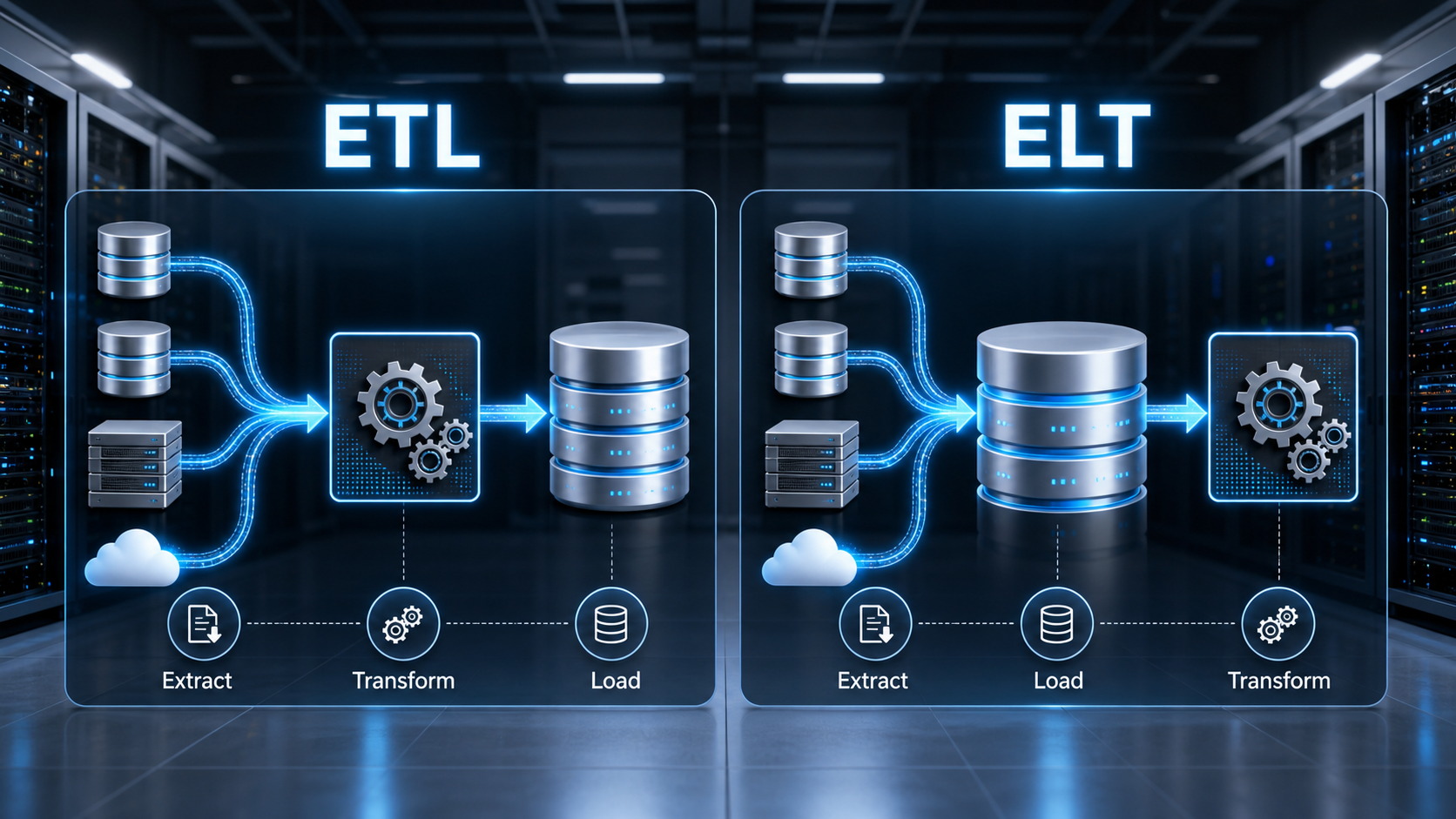
‘ETL vs ELT’ is one of the most common interview questions in data — and one of the most over-complicated. The difference comes down to a single letter’s worth of ordering: do you transform data before you load it, or after? This guide is for beginners who want the real distinction, the reason the default flipped, and a straight answer on which to choose.
ETL and ELT in plain terms
Both terms describe the same three jobs: Extract data from a source, Transform it into a usable shape, and Load it into a destination. The whole ETL vs ELT distinction is purely the order of the last two steps — it’s the same data pipeline, run in a different sequence.
ETL (Extract, Transform, Load) cleans and reshapes data on the way in, so only polished tables land in the warehouse. ELT (Extract, Load, Transform) drops the raw data in first and does the cleaning afterward, using the warehouse’s own power to run the transformations.
The one difference that matters: order of operations
Everything else is a consequence of one choice: where transformation happens.
| Step | ETL | ELT |
|---|---|---|
| 1 | Extract from source | Extract from source |
| 2 | Transform on a separate server | Load raw into warehouse |
| 3 | Load clean data into warehouse | Transform inside warehouse |
In ETL, a dedicated processing tool does the heavy lifting before the warehouse ever sees the data. In ELT, the warehouse is powerful enough to do that work itself, so you skip the middle server and transform the data in place.
Why cloud warehouses changed the default
For decades ETL was the only sensible option. Storage and compute were expensive, so you cleaned data down to just what you needed before loading it — you couldn’t afford to store the raw mess.
Cloud warehouses broke that constraint. They separate storage from compute, make storage cheap, and scale processing on demand. Once it’s cheap to store everything and fast to transform inside the warehouse, loading raw first (ELT) stops being wasteful and starts being convenient. That shift is why ELT became the modern default across the modern data stack.
Trade-offs side by side
Neither approach is ‘better’ in the abstract; they trade different things. Here’s the honest comparison:
| Factor | ETL | ELT |
|---|---|---|
| Raw data kept? | No, only clean data lands | Yes, the raw is stored too |
| Where transforms run | A separate engine | Inside the warehouse |
| Best when | Strict privacy, heavy pre-processing | Flexible analytics, cheap storage |
| Watch out for | Rework if needs change | Warehouse compute bills, messy raw layer |
Notice the ELT bet: keep the raw data so you can re-transform it later when the questions change. That flexibility is the main reason teams pick it.
When ETL still wins
ETL is far from dead. Transforming before loading makes sense whenever raw data shouldn’t land in the warehouse at all.
- Sensitive data you must mask or drop before storage (privacy or compliance).
- Heavy cleaning that’s cheaper on a specialized engine than in the warehouse.
- Legacy and on-premise systems where storage is still costly.
- Well-defined, stable transformations that rarely change.
If regulators care where personal data lives, transforming it out before it lands isn’t just an optimization — it can be a requirement.
When ELT is the better call
ELT shines when you value flexibility and you already have a capable cloud warehouse.
- You want to keep raw data to answer future, still-unknown questions.
- Your team knows SQL and wants to model data in the warehouse.
- You use a cloud warehouse or lakehouse that scales compute on demand.
- You want transformations version-controlled and tested like software.
For most new analytics projects in 2026, this describes the situation exactly — which is why ELT is usually the starting assumption.
What most teams do in 2026
In practice, the honest answer is ‘mostly ELT, with ETL where it’s needed’. Teams load raw data into a warehouse and transform it there with SQL, but still pre-process sensitive or enormous data before it lands when the situation calls for it.
So don’t treat ETL vs ELT as a religious war. It’s a per-dataset decision: default to ELT for flexibility, and reach for ETL when privacy, cost, or a specialized engine makes pre-load transformation the right move.
Frequently asked questions
Is ELT always better than ETL?
No. ELT is the more common default for cloud analytics because storage is cheap and warehouses are fast, but ETL is still the right choice when you must clean or mask data before it’s stored. The best teams use both, chosen per dataset.
Does ELT mean I don’t need to transform data?
Not at all — it just moves the transformation later. With ELT you load raw data first and then transform it inside the warehouse, usually with tested SQL models. The cleaning still happens; it simply happens after loading instead of before.
Which should I learn first as a beginner?
Learn ELT, because it’s what most modern cloud teams use and it leans on SQL you’ll want anyway. Understanding ELT also makes ETL easy to grasp, since it’s the same three steps in a different order. Focus on writing clean, tested transformations in the warehouse.
Is ETL outdated?
No, it’s just no longer the automatic default. ETL remains common in regulated industries, on-premise systems, and pipelines with heavy pre-processing. Calling it outdated confuses ‘less common by default’ with ‘obsolete’ — and it’s neither.
ETL vs ELT sounds like a deep divide, but it’s really one question — transform before or after loading — with cheap cloud storage tipping the default toward ELT. Know both, choose per dataset, and you’ll sound like someone who actually gets it. For the big picture, start with our cornerstone guide, or see where the data lands in data warehouse vs data lake.
Last updated: July 6, 2026


Comments
Post a Comment